
Why there is no "perfect" writing routine
Lessons on discipline, momentum, and observation from the daily rituals of Murakami, Hemingway, and Sedaris.


I’ve spent an unreasonable amount of time dissecting the morning routines of writers. As a chronic overexaminer, I look for patterns in my favourite authors to gain insight into their process.
The writing compels me to want to learn more about the mindset of the person behind the page.
- What do they prioritise in life?
- How are their hours and months spent?
- What sacrifices did they make to bring this to life?
Great writers leave great clues.
The same goes for other disciplines like sports, music, and business.
The nuance of the outcome is never quite as interesting to me as the process. I would much rather understand the invisible routine that enabled the touchdown, the Grammy, or the best-seller.
Though being inspired by others helps me construct my own creative scaffold, there comes a point where too much influence breeds confusion. The hundreds of possibilities for how, when, or what to write can feel crippling.
Should I write in the mornings or evenings? Before or after working out? Should I focus on a 90-minute time block or shoot for a specific word count?
I’ve realised that no routine that proved fruitful for others will neatly slide into my life. After cycling through dozens of schedules hunting for a perfect fit, I’ve learned the real truth:
The perfect routine doesn’t exist.
There is only the routine that suits the current project or stage in life. Testing others’ methods is inevitable on the path to finding my standard.
This requires honesty with what works and what doesn’t. I must be able to discern what is actually required in my routine to help facilitate my best work and endure the seasons of a writing life.
Sometimes less is more. Keeping it simple to begin with, knowing it will likely morph over time is key. To find that simplicity, what better place to look than the masters?
Haruki Murakami
Murakami’s routine is arguably the most famous in modern literature because of its extreme, almost military-like rigidity.

He famously said that when he’s in “novel mode”, he becomes a machine writing from 4 AM for five or six hours.
Later, he runs 10km in the afternoon before winding down with low-effort activities like reading and listening to music.
“I keep to this routine every day without variation. The repetition itself becomes the important thing; it’s a form of mesmerism. I mesmerize myself to reach a deeper state of mind. But to hold to such repetition for so long—six months to a year—requires a good amount of mental and physical strength.”
Ernest Hemingway
While Murakami relies on a clock, Hemingway relied on momentum. He saw writing as a craft that required daily discipline. His early years in journalism trained him in economy and consistency under pressure.
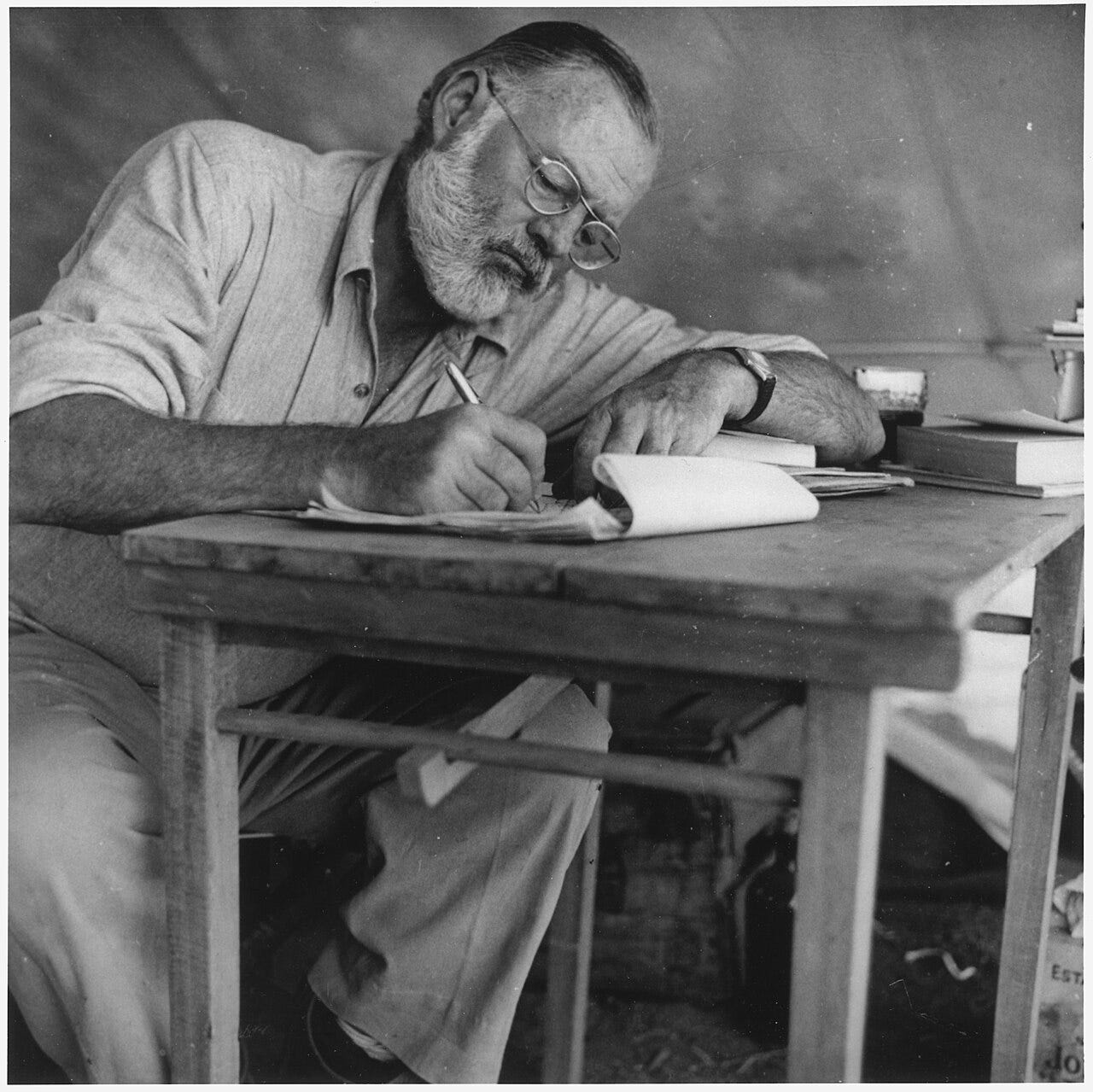
He wrote at first light, often standing at a tall desk, and worked until midday. He deliberately stopped writing while he still knew what would happen next, ensuring he could return the next day with clarity.
“You write until you come to a place where you still have your juice.”
His afternoons were reserved for living—conversation, sport and observation—experiences that later became the texture of his work.
David Sedaris
Hemingway and Murakami found their “juice” in the quiet of their rooms, David Sedaris finds his in the noise of the street.

Sedaris builds his writing life around attention rather than a fixed morning ritual. His process is less about manufacturing inspiration and more about the art of noticing.
He spends large parts of his day walking and observing people, overhearing conversations, and noting oddities in a pocket notebook.
“You need to be in the world and you need to be engaged with the world. It’s my job to collect jokes. It’s my job to collect startling images. And so when I’m out in the world, I’m at work. And I’m a professional.”
Since 1977, he has kept near-daily diaries, treating them as a running log of human behaviour, embarrassment, and detail. He essentially mines daily life for the small and strange truths.
These are not blueprints to be followed precisely. They are permissions. Permissions to stop looking for the “correct” routine and start building the one that survives the fluctuations of real life.
If you enjoyed this post, join The Creative Apprentice to get my weekly dispatches on mastery, craft, and the creative process delivered directly to your inbox.


Discussion