
How to Build a Creative Standard When No One is Watching
How to stop negotiating with your potential and start treating your creative work as a non-negotiable standard.


Saturday at 6:00 PM is my refuge. For most people, finishing work means leaving a building.
For me, it just means closing a series of tabs. My office is in a spare bedroom, and my business is in the garage.
The boundary between life and work is paper-thin.
When date night rolls around at 6 o’clock, that’s the only time I truly get to leave the job. It’s the one brief window during the week where the negotiation between my health, my business, and my writing finally stops.
By then, I don’t want to optimise anything. I don’t want to be ‘on’. I want the low-level noise to disappear.
But the silence always makes the pattern of my week impossible to miss.
When you spend forty hours a week keeping a business running, and another forty focused on creativity and health, maintenance starts to feel permanent.
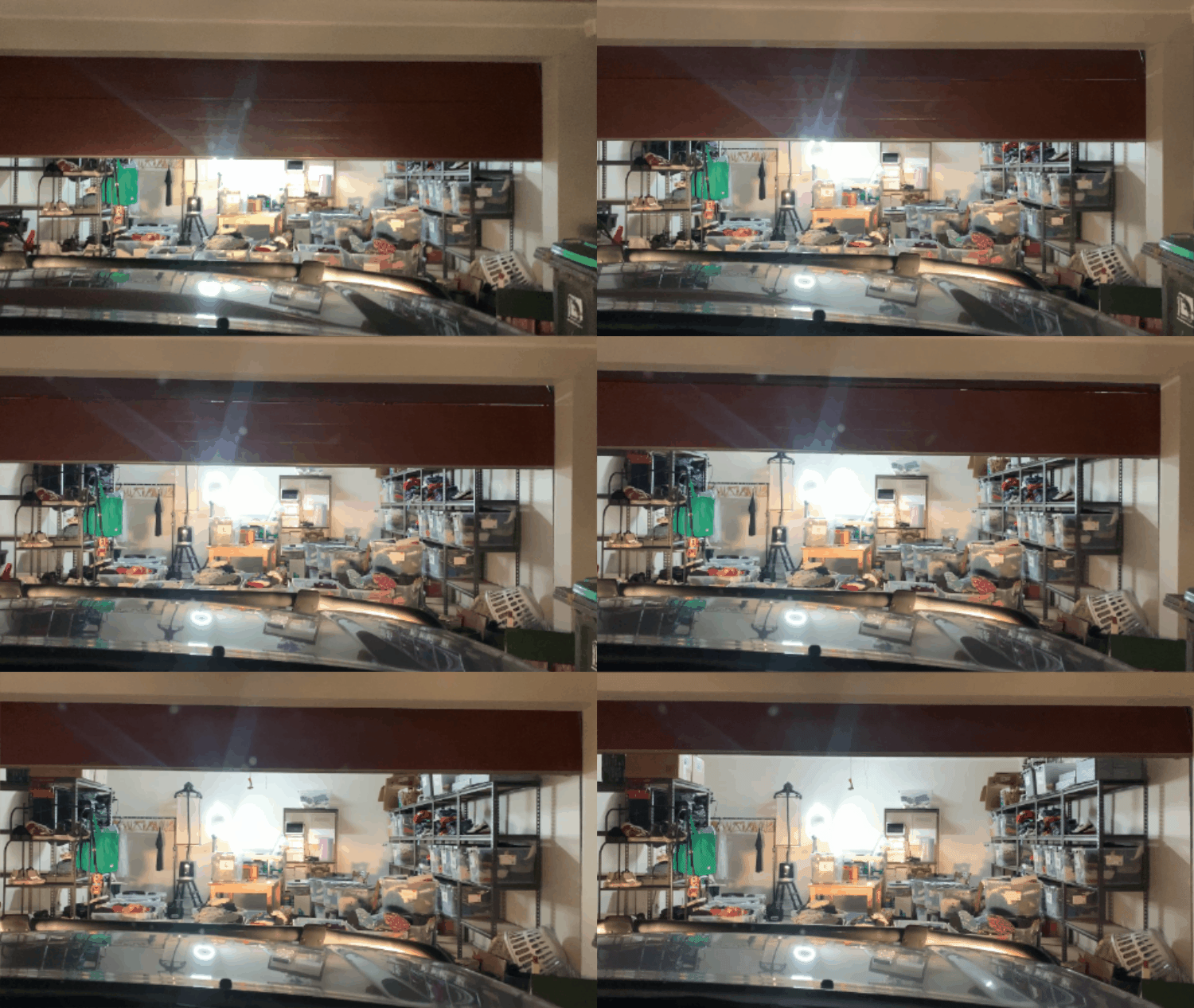
The work that used to matter the most gets demoted, and what was once the mission becomes a side project.
At some point, you accept the cage because it’s safe and pays the bills. Eventually, safety makes ambition feel indulgent rather than necessary.
The mental handcuffs
This is where the friction begins.
I start my mornings with creative work. That’s when I’m sharpest and when my ideas feel most alive. The rest of the day belongs to the business, mostly:
- Packing orders.
- Replying to emails.
- Taking photos of inventory.
It’s a shift from building something special and fulfilling to managing something repetitive.
While I’m in the garage or at my desk, my mind drifts back to the work I actually want to be doing. Not because the business is difficult—it isn’t—but because it consumes the same mental bandwidth.
It feels like I’m wearing handcuffs.
I can’t immediately pursue an idea or a thread of interest whenever I want to. The business must come first. It’s a necessary evil.
The business funds my life, gives me stability and buys me freedom. But it also drains my energy with work that doesn’t challenge me.
Writing is much harder, and because it asks more of me, it’s easier to postpone or skip.
When your head is preoccupied with maintenance, meaningful work seems like a luxury. Reserved only for those with perfectly clear schedules.
It becomes a convenient excuse. It allows you to stay in the cage, unchallenged, accepting a 'good enough' life simply because the alternative is so much more demanding.
Seeing the mud
I’ve been looking for a way to reframe this tension instead of fighting it.
Last year, I read The Book of Five Rings by Miyamoto Musashi. It’s about the philosophy of a legendary samurai who had already reached mastery.
At the time, it felt distant. Still useful, but very hard to relate to when you’re still in the middle of the struggle.
More recently, I started reading the manga Vagabond by Takehiko Inoue, which is a fictionalised telling of Musashi’s life.
It acts as a much better mirror for my life. Even though it’s about a swordsman, it isn’t the combat that resonates with me—it’s the unrelenting obsession.
The story shows the mistakes, the hunger, and the brutal effort it took for him to become a master. He didn’t train in ideal circumstances; he was training in the mud and the rain to keep his “Way”—his Hyōhō—alive.
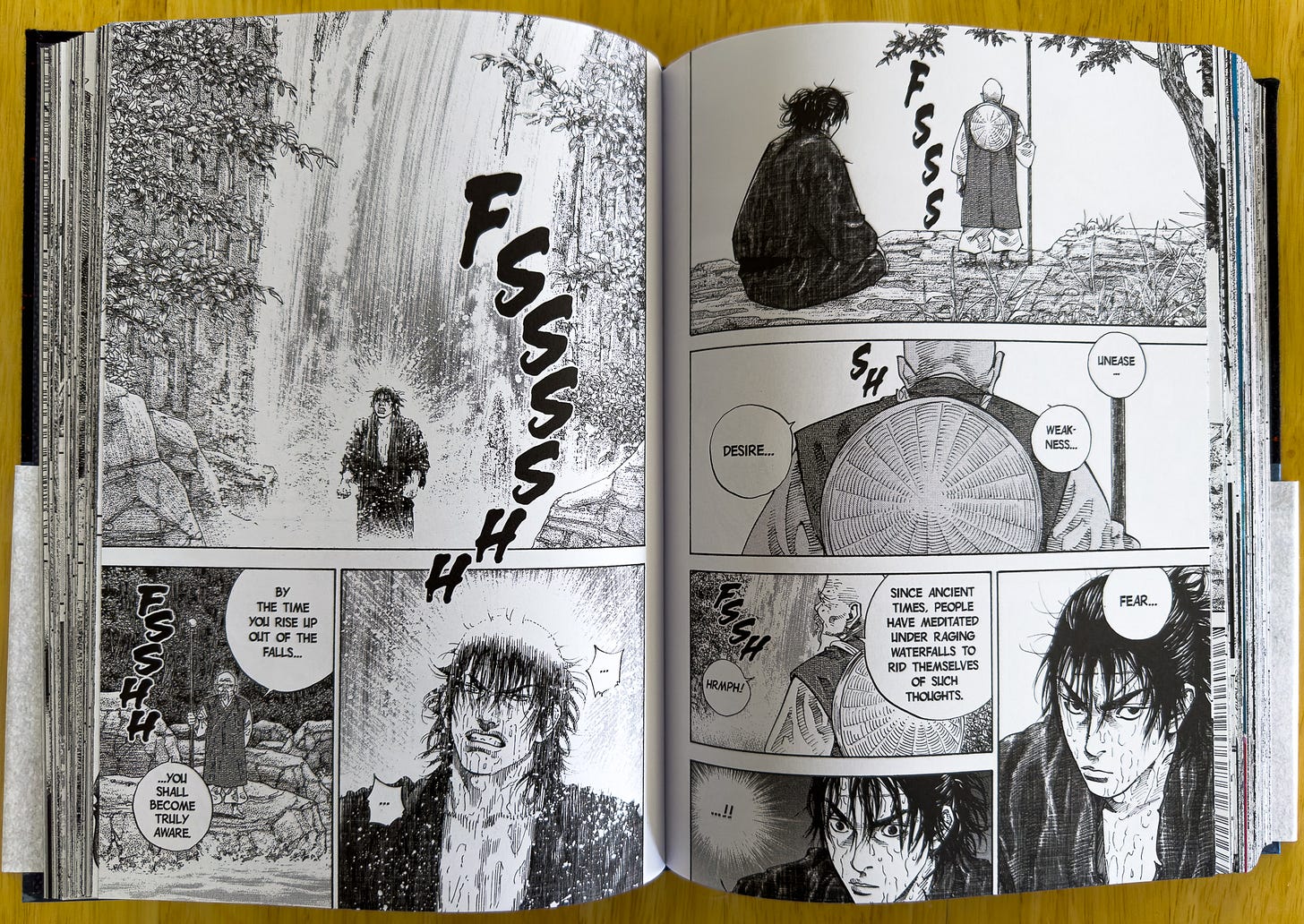
Some days he fought. Others, he simply survived. But his discipline didn’t change with the conditions.
I’m starting to see my business as a version of Musashi’s ‘mud and rain’.
It isn’t the work I want to be remembered for, but it’s the environment I have to navigate to keep my writing and creativity alive.
The business isn’t the enemy.
It provides the financial grounding that prevents my creative life from becoming a desperate scramble for survival.
The Monk and the Rule
One of the hardest parts of working for yourself is that no one is watching.
I am the CEO, the employee, and the janitor. I’m the only one who decides whether the business takes over or if my creative time is protected.
When I choose the path of least resistance, there’s no one to call me out. There’s no meeting about my performance. I just have to live with the fact that I negotiated with my own potential.
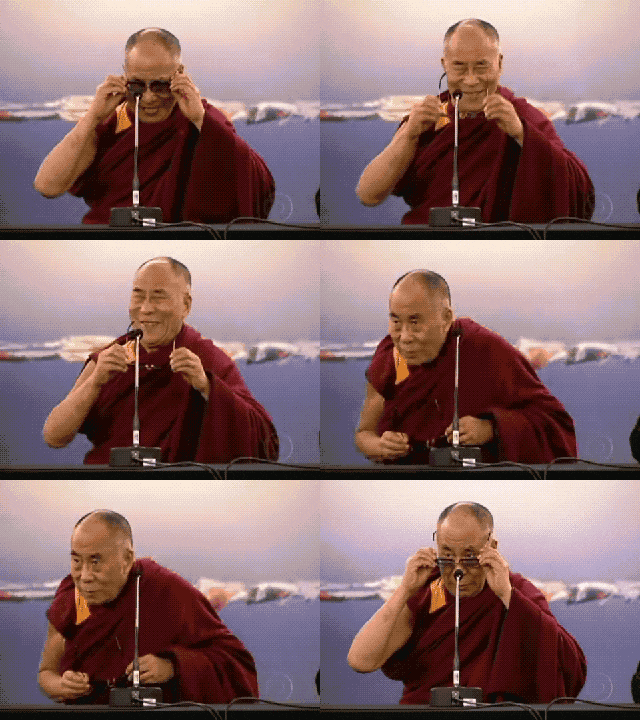
It feels like a monk sitting in the back of my mind—a silent witness each time I choose to be ‘busy’ instead of being ‘great’.
When no one else is watching, motivation becomes the only thing you can lean on. The problem is that motivation can’t be trusted. It changes with context.
The business feels urgent. But the creative work feels important. So without clear rules, I end up negotiating with whichever voice is the loudest.
All that remains then are my standards. Musashi had his Way; I have mine. If my standard sets the bar, then my rules are what stop me from lowering it.
Musashi didn’t become a legend by waiting to feel inspired. His Way stayed the same whether he was winning or bleeding in the mud. The conditions changed, but the standard didn’t.
A standard is only useful if it’s non-negotiable. Upholding it means believing the work is worth the effort, even when no one is watching.
Right now, the rules within my standard have to account for my dual roles:
- In the morning, I am a writer.
- In the afternoon, I am a businessman.
These rules have to be self-imposed. When I fail them, there’s no one else to blame.
There is only the Monk observing as I neglect my Way.
The daily choice
The real battle I fight isn’t between failure and success. It’s between the ‘good life’ of comfortable maintenance and the ‘great life’ in pursuit of creative mastery.
That negotiation happens every day, especially when the handcuffs feel the heaviest.
The truth is, I’m tired of just maintaining a business.
I’ve spent enough time being comfortable and admiring the excellence of others from a distance.
The difference between where I am and the people I respect most isn’t talent; it’s the set of rules they refuse to break, even when they’re busy, bored or doubtful.
The reprieve that begins with date night is a necessary reset. From Saturday evening through to Sunday night, the negotiations and the friction stop. The tabs stay closed.
But the weekend always ends.
Monday morning arrives without fail as a fresh start and a chance to reclaim my standard. I can either negotiate with the routine, or I can follow my own Way.
I don’t resent the work that keeps the lights on. I accept it as part of my path. What matters is whether I hold my standard once the day starts to get messy.
That choice is the only thing I truly own.
Disclosure: Some links above are affiliates. They support my work at no extra cost to you.


Discussion